Stinging insect nest abatement and structural removal in Los Angeles addresses defensive colonies that nest in wall cavities, attic overhangs, and subflooring across regional architectural styles. In coastal…
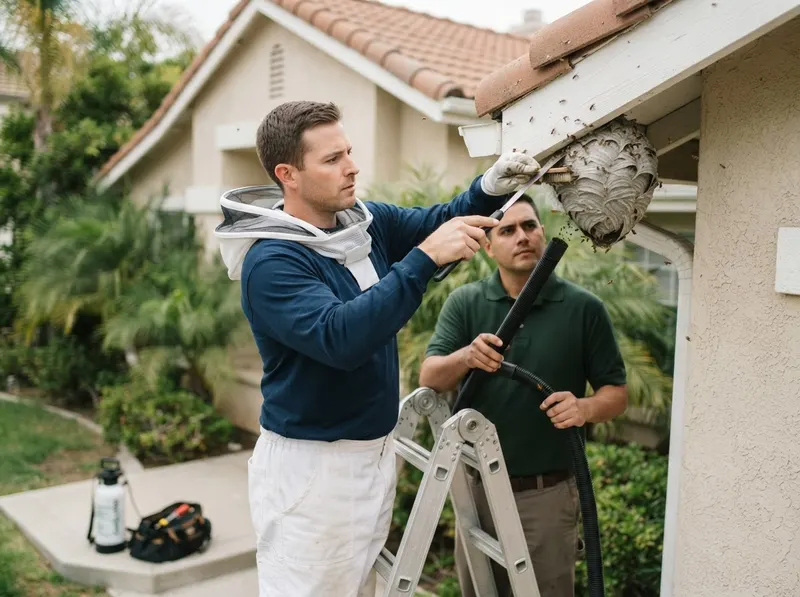
Stinging insect nest abatement and structural removal in Los Angeles addresses defensive colonies that nest in wall cavities, attic overhangs, and subflooring across regional architectural styles. In coastal microclimates like Venice and Pacific Palisades, higher ambient humidity drives paper wasps under exterior rafter tails, whereas intense summer temperatures in Sherman Oaks and North Hollywood force yellowjackets and honeybees into structural voids to thermo-regulate. Standard exterior chemical spraying neutralizes flying foragers but leaves the primary brood, queen, and raw honeycomb intact inside the wall. When untreated combs melt under high southern California attic heat, fermenting honey, decaying pupae, and wax attract secondary scavengers including carpet beetles, German cockroaches, and roof rats. Full structural extraction physically cuts into the colonized cavity, removes the biological mass, applies botanical or enzymatic cleaners to deactivate biological pheromone markers, and seals voids using heavy-gauge copper mesh and elastomeric sealants. Homeowners should review guidelines from the US EPA Integrated Pest Management program and state structural mandates via the California Structural Pest Control Board.
Decision-fit requirements dictate whether simple topical aerosol suppression or complete invasive extraction is warranted. For exposed aerial umbrella nests under an open eave in Silver Lake or Los Feliz, a targeted knockdown and physical detachment provide rapid resolution without drywall modification. Conversely, if insects enter through weep screeds, barrel tile roof junctions, or exterior stucco cracks, frequent occurrences in 1920s Spanish Revival homes throughout Koreatown and Highland Park, a full structural breakout is necessary. The trade-off centers on interior disruption versus chronic re-infestation: an in-wall void left uncleaned guarantees repeat nesting along established pheromone trails every spring. Regulatory health parameters established by the California Department of Public Health and structural guidelines from the California Environmental Protection Agency emphasize that unextracted organic insect matter poses substantial indoor air quality hazards. Field technicians verify colony limits using non-destructive acoustic sensors and infrared imaging to minimize wall cuts before mechanical extraction begins.
Protective protocols in dense foothill communities like Echo Park and Brentwood must account for hybrid Africanized honeybee genetics, which exhibit defensive reaction perimeters up to 100 feet. The USDA Agricultural Research Service tracks regional feral colony behaviors, confirming that defensive swarms respond violently to mechanical vibrations from lawnmowers, hedge trimmers, or construction equipment. Professional intervention avoids off-the-shelf retail foam cans that irritate the colony, drive defensive bees deeper into living quarters via unsealed electrical outlets, and create toxic indoor exposure hazards. For severe environmental and worker safety standards, protocols adhere strictly to the Occupational Safety and Health Administration guidelines and NIOSH workplace safety standards. In instances involving managed agricultural apiaries, technicians coordinate with the California Department of Food and Agriculture, local vector initiatives via the Greater Los Angeles County Vector Control District, and local municipal health teams managed by the Los Angeles County Department of Public Health. BeaconHill Exterminators executes complete physical containment, surgical void opening, biological removal, and structural exclusion so that living quarters remain secure without ongoing chemical dependence.
Every job gets a firm, written price after a free on-site visit.
For standards, safe disposal, and service guidance on pest control services in Los Angeles, CA, useful references include U.S. EPA, ENERGY STAR, U.S. Dept. of Energy, Consumer.gov, U.S. Census Bureau, and Google Maps. General consumer and small-business resources are available from USA.gov, Better Business Bureau, FTC Consumer Advice, U.S. Small Business Administration, and Ready.gov.
Tell us about your stinging insect nest abatement and structural removal job in Los Angeles and we'll send a clear, written quote, usually the same day.
 BeaconHill Exterminators